Education is evolving beyond textbooks and traditional classroom methods. Today’s students learn best when they can see, interact with, and experience concepts rather than simply reading about them. Augmented Reality (AR) is making this possible by bringing complex subjects to life through immersive visual experiences.
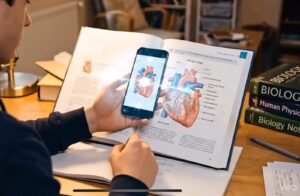
Imagine a student studying human anatomy. Instead of looking at a flat image in a biology textbook, they simply point their smartphone at the page. Instantly, a detailed 3D model of the human heart appears, allowing them to explore its structure, observe its movement, and better understand how it functions. This interactive approach makes learning more engaging, memorable, and effective.
Making Complex Topics Easy to Understand
Many academic subjects involve concepts that are difficult to visualize. Whether it’s biology, chemistry, physics, engineering, or geography, students often struggle to connect theoretical knowledge with real-world understanding.
Augmented Reality bridges this gap by overlaying interactive digital content onto physical learning materials. Students can:
- Explore realistic 3D models.
- Visualize internal structures and processes.
- Interact with educational content in real time.
- Learn through observation rather than imagination.
- Improve comprehension of difficult concepts.
By transforming static textbook images into interactive experiences, AR helps students grasp information more quickly and retain knowledge for longer periods.
A More Engaging Learning Experience
Traditional learning often relies heavily on reading and memorization. While effective to some extent, it can make complicated subjects feel overwhelming.
AR changes the learning experience by making education more interactive. Students become active participants instead of passive readers. They can rotate, zoom, and examine virtual models from different angles, creating a hands-on learning environment that encourages curiosity and exploration.
This increased engagement leads to:
- Higher student motivation.
- Better classroom participation.
- Improved concept retention.
- Greater confidence in understanding difficult topics.
Bringing Digital Learning into Everyday Classrooms
One of the greatest advantages of modern AR technology is its accessibility. Students only need a smartphone or tablet to access immersive educational experiences. Printed textbooks, worksheets, posters, or classroom materials can become interactive learning tools without requiring expensive equipment.
Teachers can enrich lessons with:
- 3D scientific models.
- Interactive historical artifacts.
- Animated engineering diagrams.
- Virtual laboratory demonstrations.
- Visual explanations of mathematical concepts.
This allows educators to create more impactful lessons while keeping students engaged throughout the learning process.
The Future of Education is Interactive
As educational technology continues to evolve, Augmented Reality is becoming an essential tool for modern learning. It enables schools, universities, and training institutions to deliver content in a way that is easier to understand, more enjoyable to explore, and better suited to today’s digital learners.
By combining physical learning materials with immersive digital experiences, AR transforms education from passive reading into active discovery. Whether students are exploring the human heart, understanding scientific principles, or visualizing complex engineering systems, Augmented Reality makes learning more meaningful, engaging, and effective.